The Morning Bro

Good Morning, Pleasantly Overdrawn Bro It's Friday, which means the coffee is doing 60% of the work and the weekend is doing the other 60%. Nobody check that math, it's a vibe, not a budget. Let's get into it. ☕
- The U.S. Treasury asked Japan to hike rates. Japan hiked rates.
- The Fed hiked, your bond fund bled, and the bank called it good news.
- A Microsoft exec wrote down the quiet part. In a court document.
- Researchers broke into OpenAI's GitHub with a little help from Anthropic's new model.
Japan hiked rates to a 31-year high — and Washington asked it to

The Bank of Japan just raised rates to a 31-year high. The textbook reason is real: Governor Kazuo Ueda says underlying inflation is finally approaching the bank's 2 percent target after months of steady signals, and when inflation shows up you raise the price of money to cool it. The un-textbook part is who was cheering from the sidelines: U.S. Treasury Secretary Scott Bessent spent the run-up openly campaigning for Japan to hike.
Here's why a U.S. Treasury Secretary cares about Tokyo's overnight rate. Higher rates pull money into a currency, so a hike props up the yen. A stronger yen makes Japanese exports pricier and American goods relatively cheaper — which is exactly what a Treasury leaning on trade wants. Japan gets its inflation fight, Washington gets its currency move, and the 'independent central bank' brochure gets a little thinner.
The last time Japanese rates sat this high, 31 years ago, the internet came on a CD in the mail. A whole generation of Japanese borrowers has never seen a rate that actually bites, and a whole generation of global investors built the habit of borrowing cheap yen to buy everything else. Both groups just got a memo.
Bond buyers are lining up for the worst-performing Treasury in 100 years
The Fed just did its first rate hike in three years, and the two groups who should be hurting most — bond holders and banks — are both saying 'more, please.' The gear: bond prices and yields move in opposite directions, so a hike hammers every bond already sitting in a portfolio while making every new bond pay more. Same event, two completely different customers.
Bond buyers: The 10-year Treasury is in its worst run in over 100 years — that's the price of the old paper falling as rates climb. But the flip side is the whole pitch: 'The higher that yields go — for at least new money — it becomes more enticing to think about putting money into bonds,' one strategist says. Translation: the same hike that turned your bond fund red is the reason fresh cash is lining up to buy. Existing holders eat the loss; new money collects the coupon.
Banks: Bankers spent the week shrugging off the quarter-point hike, and some said it could actually be good for near-term profitability. That's the bank's favorite gear: loan rates reprice up almost immediately, deposit rates reprice up whenever they feel like it. The gap between those two is the profit. So the hike that costs you on your next loan lands on your savings account somewhere between 'eventually' and 'lol.'
Zoom out: One quarter-point, three ledgers: your bond fund lost, the bank gained, and new buyers get their entry in the worst Treasury stretch in over 100 years. This is the exact bonds-lose-value-when-rates-rise mechanism that vaporized a certain Silicon Valley bank a few years back — the only difference is today's players saw it coming and are pricing it as a sale.
A Microsoft exec called AI training 'the largest theft of labor in history' — in an internal document
The New York Times is suing Microsoft (now $497.75, +1.5% 1D) and OpenAI for training AI on its articles, and the lawsuit's discovery phase — where each side has to hand over its internal documents — just produced the plaintiff's dream exhibit: a Microsoft executive calling the practice 'the largest theft of labor in history.' Not a critic. Not the Times. Microsoft, to Microsoft.
Microsoft: The quote headlined a newly unsealed court document. Here's the gear that makes it lethal: the entire defense in these cases is that training on articles is fair use — copying that's transformative enough to be legal. That argument gets a lot harder to make when your own exec described it, internally, in writing, using the word 'theft.'
OpenAI: The unsealed records also showed concern inside OpenAI over the same thing — the use of millions of news articles to build the systems. The thing about a copyright trial: your public position is set by your lawyers, and your internal position is set by whoever hit 'send' on a bad day. Discovery makes sure the jury reads both.
Zoom out: Millions of articles is the number. Every piece of reporting you ever skimmed went into the machine that now summarizes the news back to you — and the people building the machine apparently knew exactly what that was. Discovery doesn't just find the receipts. It finds the group chat.
Researchers broke into OpenAI's GitHub. Their accomplice was Anthropic's new model.
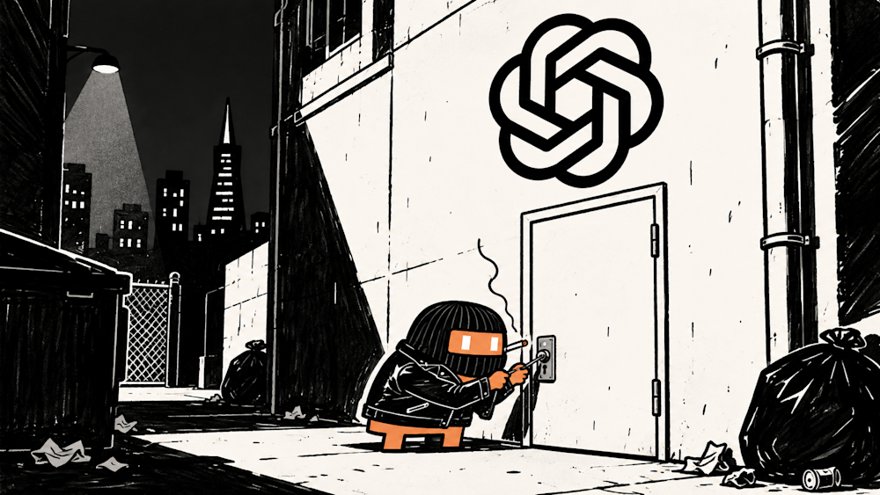
A small team of security researchers got into OpenAI — and their main tool was Anthropic's newly released Claude Opus 5. They started with an image-processing vulnerability (the code that opens a picture you upload had a bug) and used the AI coding agent to build that bug into a full exploit chain: crafted image, then a compromised OpenAI employee's ChatGPT account, then the company's internal GitHub environment, where the source code lives.
The gear that matters isn't the bug. It's the economics. A raw vulnerability is worthless until someone does the grinding, expert-level work of turning it into a working exploit and chaining it into something bigger — that labor was the moat, and it's what kept sophisticated attacks expensive and rare. AI coding agents just made that labor cheap. One bug, one employee account, one company's crown jewels, with the heavy lifting done by a model that just shipped.
So what for you: every app on your phone has an image parser, and every one of them has a bug somebody hasn't found yet. Finding and weaponizing it used to be the hard part. Now it's a prompt.
Russia's most popular messaging app got there by being mandatory

Over the past 18 months, tens of millions of Russians have been made to install Max — a violet-blue messaging-and-payments app pitched as the patriotic alternative to Telegram and WhatsApp — and researchers now say it amounts to a backdoor on the device. The mechanism is the whole point of the 'super-app' model: one app that holds your chats, your money, and your identity is one app that already has every permission it needs to watch all of it.
Governments used to have to break into phones. That's expensive and it gets noticed. The cheaper play is to make the phone volunteer: mandate one app, have the glitterati hype it in rap videos and comic routines so it feels like a choice, and wait. By this summer Max was the country's most-used messaging app — not because it won, because the alternative was not having one.
Why it matters to you: every 'one app for everything' pitch you've heard in the West is the same product with a nicer owner. The convenience and the surveillance are the same feature, just marketed to different people. Russia just skipped the part where they pretend.
Who becomes a senior engineer if nobody hires the juniors?
Everyone in tech agreed AI would kill the junior engineer job — coding agents write the code, so why pay a kid out of college to write more of it? The problem is the career ladder only works one way: junior engineers learn on the job, fixing bugs and shipping small features until they build real judgment, and those juniors are the only place senior engineers come from. Cut the bottom rung and you haven't saved money. You've cancelled your future senior staff.
Here's the gear. The bug-fixing grunt work was never just labor; it was the training. Now coding agents handle much of it, so companies assume they can skip hiring the humans who used to do it. But nobody becomes a senior leader with judgment, intuition, and a solid understanding of AI-native ways of building by skipping the years where you build those. The company that stops hiring juniors today has exactly zero home-grown seniors who understand AI-native building a decade from now — and it'll be hiring them, at a markup, from whoever didn't.
If you're job hunting: this is your pitch, verbatim. If you run a team: the industry is eating its own pipeline and calling it efficiency, and the winners are the shops — like this one — quietly hiring more juniors while everyone else brags about not.
- Iran's Strait of Hormuz 'toll booth' took tanker payments through a bitcoin exchange, the U.S. says. Crypto finally found product-market fit.
- Australia is weighing a 'world-leading' ban on smart glasses in government buildings. Your face computer is now a security threat, mate.
- Mazama raised $135M to drill three miles down into superhot rock; one well gives 15 MW around the clock. Data centers, take notes.
- Apple Watch Series 12 is back in ceramic, pressed at 21,000 psi and sampling your body every five seconds. It knows.
- The Coast Guard and FBI boarded a Texas-bound supertanker mid-voyage over a suspected foreign hack. Ransomware, but with a hull.
| Ticker | Price | 1D | 1W | YTD |
| MSFTMicrosoft | $497.75 | +1.5% | +1.1% | +5.2% |
| AAPLApple | $337.00 | +1.4% | +3.2% | +24.4% |
| GOOGLAlphabet | $347.33 | +1.3% | +4.4% | +10.2% |
1D / 1W / YTD = move vs prior close / 5 sessions ago / Jan 1. Pulled fresh.




Forwarded this? Grab your own — free →
Rate today's issue or drop a hot take — just hit reply. Tell us 1–10 and what to fix; it lands straight in our inbox.
Live prices in parentheses were pulled fresh from the market (snapshot Sep 18, 2026) and move every second — they're a snapshot, not a quote you can trade on.
Bro-sclaimer: Everything here is for informational purposes only and is not financial advice. As tech-savvy bros, you know the drill — do your own research before making any investment decisions. Don't be a dummy, Bro.