The Morning Bro

Good Morning, Caffeinated & Confused Bro Monday again, and your coffee is doing the Lord's work of pretending you slept. Take the first sip before you check anything — the world will still be on fire in ninety seconds, I promise. Let's get into it. ☕
- Baidu's chip unit wants $50B and a side order of semiconductors.
- Harvard quietly admits the middle-class home was a fluke.
- AI's real wall isn't chips — it's plugging in.
- Unilever calls the World Cup 'a Super Bowl every two days.'
Baidu's chip unit wants $50 billion — and asks buyers to order chips on the way in
Baidu (now $104.22, +0.2% 1D)'s AI chip arm Kunlunxin is planning a Hong Kong IPO at a $50 billion target valuation, per The Information on Sunday. Here's the unusual twist: the company reportedly asked prospective IPO investors to also commit to buying its semiconductors.
Walk the loop. An IPO valuation is basically the market betting on how many chips you'll sell. Kunlunxin is asking the people placing that bet to also become the customers who make the bet true — buy the stock, and please buy some chips while you're in the cart. You're not pricing in demand anymore; you're being asked to manufacture it.
The catch: Reuters said it couldn't independently verify the report, so park your outrage. But a $50 billion valuation that comes with a soft purchase order attached is the kind of thing that works great right up until everyone needs the music to keep playing.
Was the middle-class home always a fluke?

Harvard's 2026 State of the Nation's Housing report reads like an affordability brief, but the real argument underneath is darker: the era when an ordinary American could just expect to own a home may have been the exception, not the rule.
The mechanism is history, not the market. The postwar boom that pushed homeownership up 20 percentage points in a single generation wasn't capitalism doing its thing — it was the GI Bill shipping veterans to the suburbs, federal mortgage guarantees lowering the down-payment bar, highways unlocking cheap land, and strong unions pushing wages up faster than house prices, until about 1973. Pull those four levers out and the 'crisis' Harvard first flagged in 1977 just comes roaring back.
And the numbers are brutal. In 1970, nearly half of all families could afford a median-priced home; by 1975, only 27% could. Researchers warned a house might hit $78,000 by the 1980s as a doomsday figure — the median new single-family home in 2025 was $417,400. Existing-home sales are now sitting at three-decade lows.
The 'so what': The line Harvard won't quite say out loud: homeownership is drifting from something you earn to something you inherit. If your parents bought before the window closed, you're set. If they didn't, you're renting the math.
AI's real wall isn't chips — it's plugging in
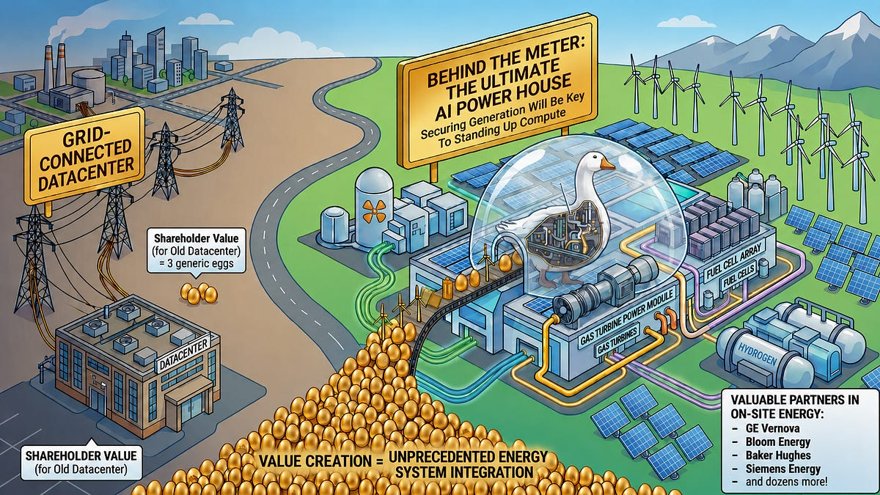
Everyone's fighting over GPUs, but the actual chokepoint is the wall socket. The U.S. grid can't connect new data centers fast enough, so operators are going 'behind the meter' — building their own gas turbines and power plants on-site instead of waiting years for a utility hookup.
Behind-the-meter just means you generate your own juice and skip the line entirely — no waiting on a transmission queue, no permission from the grid. The projected scale is the punchline: 40GW-plus of behind-the-meter data center capacity by 2028. For context, that's roughly the output of dozens of power plants getting built just to run chatbots, because the public grid said 'get in line.'
The bug-hunting AI race just went open-weight
Cybersecurity AI — the models that hunt software vulnerabilities — became the hot battleground this week, and the story isn't who's best. It's how cheaply and how openly everyone's catching up.
OpenAI: Unveiled GPT-5.6 Sol, its most advanced cybersecurity model, claiming it matches competing systems like Mythos Preview while using only a third of the output tokens. Tokens are basically the compute bill — so 'same result, one-third the spend' is the actual flex here.
Z.ai: China's Zhipu AI released GLM-5.2 as open-weight — meaning anyone can download and run it free — and some researchers say it matches Mythos on certain bug-finding tasks. It still lags Anthropic and OpenAI on general work, but the gap on this specific, dangerous skill shrank fast.
Zoom out: This is exactly what the U.S. has been trying to prevent by restricting China's access to top models like Mythos and Fable and the chips to train them. An open-weight model that finds exploits at near-frontier level doesn't need an export license — it just needs a download.
The 'protect the kids' fight Big Tech is actually losing

Age limits on social media stopped being a one-country experiment and became a trend. The UK just said it'll set a minimum age of 16 to access major platforms, following the precedent Australia set last year when it slapped an age limit on Instagram, Facebook, YouTube, X, TikTok and Snapchat.
Here's the gear that makes this hard for Meta (now $550.25, +1.4% 1D) to spin: the loudest critic is Arturo Béjar, a former Meta employee turned whistleblower, who's spent his time talking to parents around the world and says they all share one dread — the day their kid is old enough to go online. When your own ex-engineers are the witnesses, 'trust us, we'll self-regulate' stops landing.
Why you care: Once one country sets 16 as the line and the sky doesn't fall, the next government copies it, and the one after that. Big Tech is fighting back globally, but it's losing the public — and this is the rare fight that can't be won with a friendly app-update or a Zuck jiu-jitsu video.
Inside the one-person media company nobody calls a media company

A new close-up on OnlyFans creators frames them not as a punchline but as what they functionally are: solo streaming businesses — production, marketing, customer service, and talent all rolled into one person.
Remember our old 'Guess That Ticker' that revealed OnlyFans? The platform's still here, and the story has matured from 'lol' to 'labor' — the piece goes up close with the sex workers of the streaming era as workers, doing the same content treadmill a Netflix would, minus the staff of 400.
What does 'a Super Bowl every two days' actually cost?

Unilever (now $60.55, +0.0% 1D) — the soap-and-deodorant giant behind your shower — declared it would put half its media spend into social and creator marketing, then made the World Cup the test. As the official personal care brand of the 2026 tournament, it's calling the cadence of matches 'a Super Bowl every two days.'
The mechanism is a swap: instead of one giant TV ad, you flood the zone with people. Unilever says it has now activated 50,000 creators and influencers worldwide — from soccer star Trinity Rodman down to hyperlocal micro-creators drafted purely to pump up 'earned media' numbers — plus House of Fresh-branded pop-ups across New York City, Miami and Mexico City over 10 days.
The bet: A Super Bowl ad reaches one huge audience once a year. A tournament on home soil with a match every couple of days, multiplied by 50,000 phones filming it, is Unilever trying to manufacture that reach on repeat all summer — for the price of a lot of free product instead of one $7M spot.
- Michael Jackson biopic 'Michael' hit $977M, edging past Oppenheimer's $975M to become the top-grossing biopic ever.
- Galaxy cut the crypto CLARITY Act's odds to 50% — Senate floor time runs out before the August recess.
- T-Mobile is giving away the iPhone 17 'free' again — read: married to a 24-month bill.
- Russian high schools now mandate 17 hours of military training, including drone classes for 6th graders.
- DJI's Osmo Pocket 4P promises 17 stops of dynamic range and a new D-Log2 format in a pocket gimbal.
| Ticker | Price | 1D | 1W | YTD |
| CMCSAComcast | $23.17 | +2.1% | +3.3% | -16.3% |
| GOOGLAlphabet | $337.39 | -1.8% | -8.3% | +7.1% |
| SNAPSnap | $4.41 | +1.6% | -5.4% | -45.8% |
| METAMeta | $550.25 | +1.4% | -4.7% | -15.4% |
| TMUST-Mobile | $182.68 | +0.6% | +0.6% | -8.5% |
| BIDUBaidu | $104.22 | +0.2% | -6.8% | -30.7% |
| ULUnilever | $60.55 | +0.0% | +3.7% | -6.9% |
1D / 1W / YTD = move vs prior close / 5 sessions ago / Jan 1. Pulled fresh.



Forwarded this? Grab your own — free →
Rate today's issue or drop a hot take — just hit reply. Tell us 1–10 and what to fix; it lands straight in our inbox.
Live prices in parentheses were pulled fresh from the market (snapshot Jun 29, 2026) and move every second — they're a snapshot, not a quote you can trade on.
Bro-sclaimer: Everything here is for informational purposes only and is not financial advice. As tech-savvy bros, you know the drill — do your own research before making any investment decisions. Don't be a dummy, Bro.